Tuesday, October 18, 2011

Ann Allen Still's quilt

This is Ann Allen Still's quilt. I delivered it to her Big Mama Rhonda (Rhonda Still and Grandaddy John Lee Still) yesterday, and her mama Julie delivered the baby today. Daddy Seth is to be congratulated. Can't wait for pics.

PS:  If you are my friend, and I didn't make you a grandbaby quilt, it was because I was working and didn't have time and I didn't know how to quilt.  Still learning.

Monday, October 17, 2011

Friends make us better people

Today I was thinking how fortunate I am to have such great friends.  I hate to start naming in case I leave someone out.  I have my Bunko friends. Note that we have not played Bunko in well-over a decade.  We couldn't play for trying to join the conversation at the other table. So we just quit.  Now we go out to eat, to a play or movie, or just meet for lunch.  Kind of like the YaYa Sisters, which brings me to a reference of that movie later in this column.

I have my Fine Arts-Supper Club friends, childhood friends, and one of my best friends who I met when we were both in the bathroom at work crying over men.  Oh if we knew then what we know now.

Media experts point to the benefits of girlfriends.  If you haven't already, check out girlfriendology. com—"an online community for women to inspire you to appreciate and celebrate female friendship. Our goal is to make the world a better place one friendship at a time."

You will find a book club, shopping tips, blogs about how to be a better friend, and travel suggestions for girl trips.  One of my favorite authors, Claire Cook, devotes much of her work to girl friendships.

But back to the YaYa reference.  Not long after the movie came out, I wrote a memorial to my mother's best friend.  Here is an excerpt.

I lost my last "aunt" this week.  When Elizabeth Carter Gulledge was buried, I felt like I had buried my childhood memories of my mother and her friends with her.
"Aunt Libby" was not really an aunt-nor were "Aunt Sid" (Sidney Lee Williams of Senatobia) or "Aunt Frances" (Frances Lewers of Blytheville, Ark.).
I've told my children to say "Miss Kathy" or "Miss Becky," but my mother had me to call her special friends "aunt." When my husband and I got married he was most confused concerning the real relatives and the special friends.  
The "aunts" were especially important to me since I was an only child.  I always had the distinct impression that when one of them came to see Mama, that they had really come to see me.  They made me feel that way.  I was included in adult conversations on the couch, at the table for coffee, and other places most other little girls would have found boring.  I loved it and absorbed every word.  When I was a teenager, it finally dawned on me that I probably was not welcome in their conversations. 
"Aunt Libby" gained the status of aunthood by being one of mother's (Marjorie Dandridge) closest friends, the mother my childhood friend-Wayne, and the wife of mother's boss-Bill Gulledge of then Brown and Gulledge Motor Company. We went on some splendid adventures-from far-away-trips to Florida to local adventures in Memphis and the surrounding areas.  We ate at out-of-the-way restaurants, toured the Wonder Bread plant in Memphis, collected rocks and creepy creatures, and had picnics in her backyard. 
My out-of-state "aunt" was Frances Lewers, wife of Sam Lewers who was originally from the Looxahoma community and who had grown up with my daddy (Hayley Dandridge). After meeting, she and my mother became fast friends, and when she and "Uncle Sam" (there were adoptive uncles also) moved to Arkansas, it broke Mama's heart.  
 They called each other each Saturday afternoon.  We went on vacations together-usually to the Ozarks so we could stop by Blytheville and get "Aunt Frances" and then go on to the mountains.  Frances was with my mother when she died of cancer in the spring of 1994.  It was she that recorded all the gifts, flowers, food, helped me get through that tough time.  When I got a call that she had died on the way to church three months later, it took my breath away. 
The last of the adoptive aunts was Sidney Lee Williams.  I knew "Aunt Sid" less than the other two, but I know she was worthy of her aunthood because of her relationship with Mama.  They were co-workers at the Tate County Health Department in the 1950s.After a 12-year marriage for my parents failed to produce a child, Mama finally because pregnant.  She delivered a baby girl, Rena Gail Dandridge, on July 18, 1954.  Gail died seven days later. Mama always told me she didn't know what she would have done during that time if "Aunt Sid" had not been so good to her-at work and at home. 
When I came along 11 months later, she was my "Aunt Sid."  I have always had small feet.  Today, tucked inside tissue paper, in a cedar chest upstairs, are the hand-crocheted-booties she had made for me.  "Sid was so ashamed that I brought you to church barefooted, that she had these made for you," Mama told me many times.  
In a summer when groups of women friends are gathering to see the movie "The Divine Secrets of the Ya-Ya Sisterhood," I couldn't help but think of Mama and the special friends she had that I turned into my friends as well.  The Ya-Ya's didn't have anything on Margie, Sid, Frances, and Liz.

Wednesday, October 12, 2011

Missing Patches

"The smallest feline is a masterpiece."—Leonardo Da Vinci


Last night when I returned from obedience practice, I found our little calico cat lying in the grass, dead—the big lab sitting over her.  At first I thought maybe he had contributed to her demise, but on closer examination and considering that she was nearing her 18th birthday, I think different.

Daddy got Patches from Ralph Pinner in 1994 when he had Prestige Feed near the Senatobia Animal Hospital.   She was to be a barn cat. When Daddy had to have some 
Olivia and Patches in a painting by Robbie Boyd

minor surgery and couldn't get out everyday to feed her, I brought her here and never gave her back.

She was precious, polite, and incredibly sweet. My daughter Olivia was especially fond of her. Her Aunt Robbie painted her portrait with Patches. I know she was just a little cat, but we will miss her. 

I believe animals are God's gift to us and they are to be loved and enjoyed.  I can't keep from looking at the back door where she sat every night, looking in the window, and meowing quietly.

Bella and Patches


Tuesday, October 11, 2011

Howard's Table

I love fall. I had fun this morning getting out fall decorations and using the table runner I just finished. But I want to tell you about this special kitchen table.

Howard's table
When we added a room on to our house in 2007, we needed another dining table. Howard had an idea.

He used white oak wood (top) that came from trees harvested on our land. Daddy arranged for the white oak trees to be cut down and sawed into lumber at Golden Timber Co. sawmill across the highway from us.

The original purpose for sawing the lumber was to build horse stalls in the barn.

The barn was built in 1994, and trees cut for stalls built in 1995.  The leftover lumber was stored in the barn. Twelve years later, he reclaimed it for the table.  One of Howard's customers, Donald Kelley had a shop with various wood-working pieces of equipment. After talking about the project,  Mr. Kelley agreed to plane the white oak. His son “Duck” also helped in preparing the lumber.

The walnut trim on the table edge was Mr. Kelly's idea.

The legs were made by an Amish man, Herman Zook. Howard's brother Harry, introduced him to Mr. Zook, whose home and workshop is located in the Randolph community in Pontotoc County. The legs are made of red oak.  We couldn't call to see if the legs were finished, but finally got a letter from Mr. Zook saying they were done. All work is done by hand or by generator-driven tools since the Amish don't use electricity.

The original plan was to build two identical tables that could be used end-to-end or that could be separated. Since the our daughter Hayley was building a new house, it was decided that one table would to go her.

After many trips to the Kelley’s, our table arrived on July 15, 2007.   Last year, Howard made us a roll-around cart and got similar legs from Mr. Zook.

This table has since been the centerpiece for many meals and family gatherings.

Saturday, October 8, 2011

Making do


I decided I was about to get in trouble. So, I stopped quilting and looked for something to cook for dinner. Shrimp-Stuffed Shells.  

I had to make up a recipe. I saw something similar in a magazine but didn't exactly have all the ingredients. So I made do. I used giant shells, cooked shrimp with onion and peppers, used Artichoke Parmesan Marinara (Napa Valley Bistro—Kroger) and a mixture of mozzarella and cheddar cheese. 


My mother used to say that my Grandmother Dandridge's cooking was never the same. Sometimes it was great, and the next time not so good.  If it called for Ritz crackers, she might use saltines. One cup of sugar might be substituted with brown sugar.  But then she lived out here in Barr and didn't drive.  So, she really had to make do.

Every day she cooked lunch for two sons, teen aged grandsons, and all the farm laborers. I never saw her sit down and eat. She just hovered near the end of the table, refilling tea and getting seconds. She spent summer working her garden and canning.

Well, this looks pretty good, but looks can be deceiving. Now that I've done that, I can go back to sewing.

Friday, October 7, 2011

Floral Inheritance

Today my friend Tammy shared some of her aunt's iris bulbs.  She already had them bagged when I got there.  

This reminded me of a column I did for DeSoto Magazine.  It is even more true today than when I wrote it. 

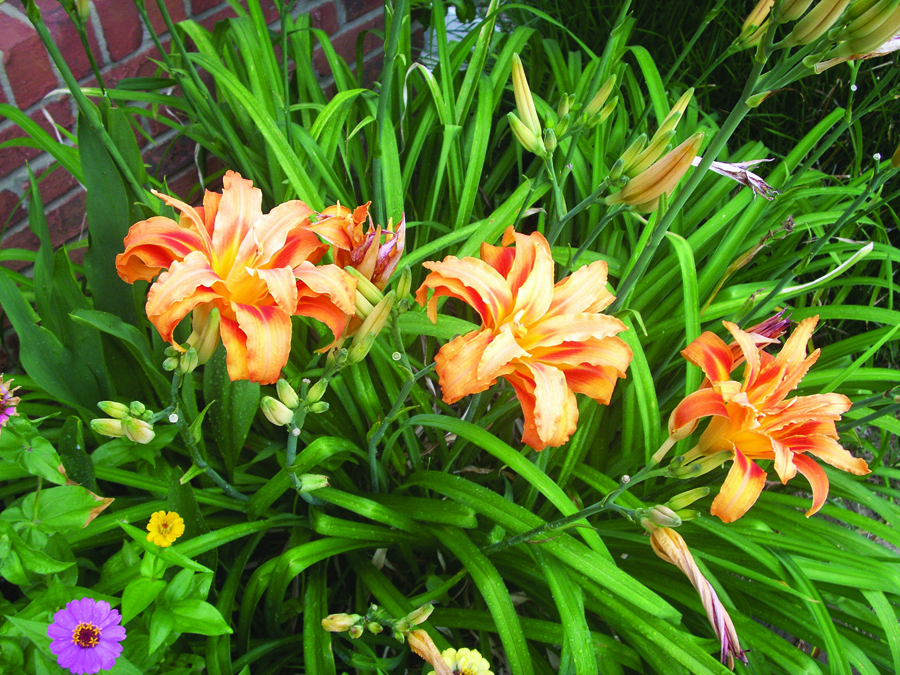
I know these are day lilies and not iris, but that's because I didn't have but a few. Now I do!


After a recent addition to my house, a friend and I were walking around the exterior admiring the new construction and lamenting the bare spots in the yard.

“I’ll have to do some landscaping,” I said. “This is a mess.”

Without hesitation, she said, “I have Hosta Lilies that I can divide next spring. They would look great over there.”

After she left I took a second look at my yard, and I realized just how many plants that are in my yard that have been shared by friends and family. Crepe Myrtles near my house and Altheas at the corner of my fence came from my Bunko buddies when we built the house 16 years ago. An English Dogwood at the corner of my house was once located at the corner of my mother’s house 10 miles away.

Day Lilies came from my mother’s best friend, an Amaryllis Lily was given to me by my husband’s elderly aunt.

Is this a Southern tradition?  I thought so.

I did a little research, and it seems there is an old superstition about thanking someone for sharing his or her plants. The legend claims that if you thank them, the plants will die.

A particular garden forum on the Internet (gardenweb.com) posted a lively discussion on the matter. One writer suggested it was a Southern tradition, but was quickly disputed by posts from Ohio and Pennsylvania. Both writers said they had been scolded when they thanked the person who shared her plants.

In a region of the country where we were brought up to say “Yes Ma'am and No Sir,” it’s hard to imagine that it would be improper to thank someone for giving you something that brings so much joy.

Every spring when that English Dogwood blooms, I think of my mother and how proud she would be that it is standing at the corner of my house. When the lilies bloom, I can’t help but remember the friends that gave them to me and the moments we have shared over the years—good and bad.

So, if that’s saying “thank you,” I apologize.

Thursday, October 6, 2011

Cotton fields and Churches

Photos from top left, Jane selecting fabrics, Free
Springs United Methodist Church, Virginia, putt-
ing the finishing panels on her Christmas 9-patch,
and the FSUMC cemetery. 
Today I went to my bi-monthly quilting sessions with the ladies of the Free Springs United Methodist Church in Harmontown.  I love going to this old church, built in 1953. Adjacent to the church is the cemetery with graves dating to the mid-1800s.


As much as I love the ladies and the quilting techniques that they teach, I really enjoy the drive to the church. Harmontown is about a 30-minute drive from my community in Barr. 


It's not unusual to see only two or three vehicles on the road. It seems like every time I make this drive, the sun is shining as I drive down country backroads, past old home sites where now a lone chimney stands.


There are several one-room rural churches on this path. I'm sure they are abandoned or meet on a monthly basis.  It reminds me of the old Mississippi of my grandparents era.  Today I passed a horse barn, cattle and goats.


This time of year you will see cotton fields on both sides of the road. Cotton is not grown in Mississippi like it was when "Cotton was King" in the South. But you wouldn't know that from looking at these crops, now tended by high-tech equipment.


In this case, the journey is just as important to me as the destination. 


Today we started planning a fall table runner.  My projects are piling up. I said when I started this, that I'd never start something until I finished the current project.  Turns out I lied. I'll let you know how this works out.  


Wednesday, October 5, 2011

Obedience Class No. 3

I really don't have much to report from last night's lesson. Cash was totally distracted and somewhat uncooperative. He did pretty good on the moving commands.....turn left, turn right, about turn. As long as he was moving, he was happy.

He really struggled with sit and down. I know how he feels. I have trouble sitting, myself.

Leave me in a chair for an hour, and I start wiggling. After an hour I'm tapping my foot and looking around for someone who can release me. It goes downhill fast from there.

But, back to the lesson. There was a cute little white, male poodle, who kept challenging him.

"Grrrrrr," said the poodle. Cash looked at him like, "Seriously, do you really want to fight?" The poodle looked around the dog between us and said, "grrrrrr.”

Cash wagged his tail and refused to sit.

I guess that's progress because my shoulder doesn't hurt as bad as it did last week. More work to do before the next lesson.
Sit, please!!!

Tuesday, October 4, 2011

Where's the water?

This is the three-acre lake behind my house.  Yep, it was once a three-acre lake and will be one again. In the spring of 2010 when we had several big rains in one week the levy failed, leaving a big sink hole. This put a cramp in my family's fishing plans.

This lake means a lot to us. It was put in here on this property in the 1960s by my grandfather Cathey S. Dandridge. The place where we now live was once pasture land for daddy's band of Appaloosa mares and colts and later for cattle (Salers and Charolais). It has double meaning for our family. Howard's father, A.M. Patterson, who worked for our local Soil Conservation Service did the surveying when the lake was built.

So after the sink hole developed, we had to ask the kids not to go down there in fear that the wall would collapse more.  We got good news this spring that there was funding to replace the drain pipe and rebuild the levy.

Starting removal of trees

We made a grand ole time out of the whole deal.  My daughter Hayley brought her friends and their children and they all came with nets hoping to scoop up fish when the levy was cut.  You understand, there is not a lot to do out here in Barr. The fish scooping was a failure.
Kids and friends

Making the first cut
The track hoe came about noon one May afternoon.  First they had to clear the trees on the levy to prevent roots from weakening it.  That took forever. This photo shows the track hoe making its first cut after clearing the trees. That was about 5 p.m. The kids (and big kids) were waiting with their nets. 

Finally about 6 p.m. they cut through to release the water.

Breakthrough
There were no fish. They either mired up in the mud or went with that fast-moving water and we didn't see, "a single feesh," as one of the four-year old guests said.  They were sad. But that didn't stop them from wading in the muddy, stinky mire with nets.  When they realized there were no fish, the dads started shooting turtles and a beaver that probably caused some of this trouble in the first place.

They all stayed and we ordered pizza instead of cooking fish as planned. The kids swam their dirty little selves clean in my pool. 

At the end of July the lake had drained enough to complete the dirt work and install the new drain pipe.

We are good to go now. Bring on the rains of winter. By spring maybe we can stock a few fish and start fishing again—in about two years.


Sunday, October 2, 2011

Journal entry revisited—THE NAME TREE


I come from a family who loves to write their names on things. Hanging in my hall is a family “friendship quilt” from 1939 bearing the names of my ancestors and members of our small community in Barr, Miss., located in eastern Tate County, not far from Senatobia. When plastic label makers came out in the 1970s my father eagerly punched out his name and branded it on everything from books to furniture. It’s no wonder that my family also has a tradition of writing on trees.

Located in the woods bordering one of our lower pastures stands a 100-year old Beech tree whose smooth bark is etched with the names of our family, friends, and an occasional name that we can’t recognize.  Maybe a hunter saw the tree and couldn’t resist leaving his mark.

For us—the Dandridge family of Tate County—the tradition must have started in the early 1930s judging from the old carvings which are now faded and hard to read. My grandchildren are the sixth generation to call this place home.  I must have been about eight years old when my father took me by the tree on one of our horseback rides, got off his horse, wiped his pocket knife off on the leg of his jeans, and carefully carved my NLD right below the initials he and his father had carved in their younger days.

I was fascinated reading the initials that I could recognize—my uncle, my mother’s best friend, my cousin who later died at an early age, my husband and our children.  I couldn’t wait until my children were old enough to sign the tree. They signed it more than once.

It seems we aren’t the only family writing on trees.  I contacted my friend Bud Donahou, who happens to be an instructor in the science department where I work at Northwest Mississippi Community College, to make sure the species of this tree was correct. He knew immediately what I was talking about. “Oh, that’s probably a beech,” he said.  “That’s the carving tree.  There is a story about Davy Crocket carving on a beech tree.”

Apparently the tradition goes back farther than Crockett. It has even inspired poetry. English poet Thomas Campbell (1777-1844) wrote these verses in his poem “The Pleasures of Hope.”

“Youthful lovers in my shade
Their vows of truth and rapture made,
And on my trunk’s surviving frame
Carved many a long-forgotten name”

Those old inscriptions on my tree have already begun to widen and disappear leaving only a scar on the bark. I can’t wait for my four grandchildren to carve their little crooked initials on that old tree. It will be up to them to see that the tradition continues.   

And it has.  See photo of Howard helping kids carve on the tree. My mother's initials MLD—Marjorie Latham Dandridge—can be seen on the trunk. 

Originally published in DeSoto Magazine.